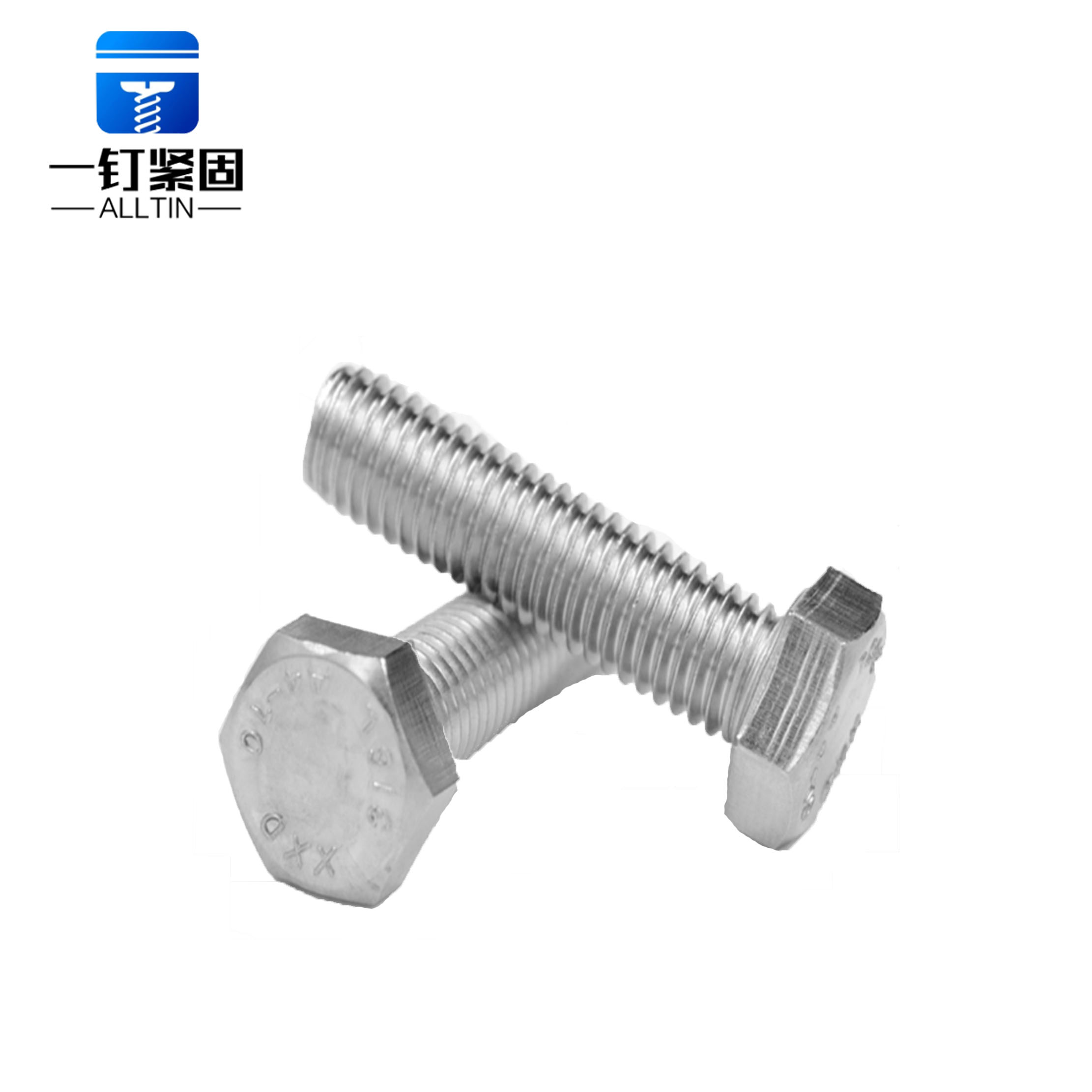
Compared with socket head cap screws, hexagon head bolts have a simpler head structure, which can be directly formed by forging or cold heading. With fewer processing steps, higher production efficiency and lower material consumption, they offer a significant cost advantage in mass production, making them a highly cost-effective fastener in the market.
Core Product Advantages
As a highly versatile fastener, the hexagon head bolt has outstanding core advantages, mainly reflected in three aspects:
First, wide tool compatibility. No special tools are required; ordinary wrenches, ring spanners, sockets and even power tools can be used, greatly facilitating installation and disassembly. It is especially suitable for applications requiring frequent assembly, disassembly and maintenance. Even with slight wear on the head, it can still be removed smoothly with tools such as pipe wrenches, demonstrating excellent damage resistance.
Second, excellent load-bearing performance. The large contact area between the head and the tool allows it to withstand higher torque, making it suitable for heavy-duty applications and performing well in fields such as heavy machinery and construction steel structures.
Third, complete specifications and strong adaptability. A variety of materials, strength grades and surface treatment options are available to meet diverse connection requirements in different scenarios.
Materials, Specifications and Surface Treatment
In terms of materials and specifications, hexagon head bolts have formed a complete product system that can be flexibly selected according to different application scenarios.
In terms of materials, they are mainly divided into two categories: stainless steel and carbon steel / alloy steel.
Stainless steel, mainly grades 304 and 316, offers excellent corrosion resistance and is suitable for humid, acidic or alkaline environments or applications requiring high cleanliness, such as food processing machinery, medical devices and coastal construction.
Carbon steel and alloy steel focus on high strength. Through different heat treatment processes, they are available in various strength grades including 4.8, 5.8, 8.8, 10.9 and 12.9. Among them, grade 8.8 is the most widely used, while grade 12.9 is the highest commercial strength grade, suitable for heavy machinery, key steel structures and other applications with extremely high strength requirements.
For surface treatment, multiple anti-corrosion solutions are provided based on service environment requirements:
— Galvanizing (blue-white zinc, colored zinc) is the most common, suitable for dry indoor environments;
— Hot-dip galvanizing provides a thick coating with strong anti-corrosion performance, widely used in heavy-corrosion scenarios such as outdoor steel structures and power transmission towers;
— Dacromet and Geomet treatments eliminate the risk of hydrogen embrittlement and offer superior corrosion resistance, widely applied in high-end fields such as automobile chassis and high-speed rail components;
— Black oxide finish is mainly used for non-critical internal mechanical parts, providing mild rust prevention and aesthetic effects.
In terms of specifications, hexagon head bolts cover a wide range of sizes from M6 to M36, ranging from standard small sizes to large high-strength types, suitable for various connection needs from household furniture to large bridge